AI From the Inside: Your AI Initiative is More Than a Technical Solution

Michael Schmidt

Michael Schmidt

CEO and Co-founder of Nerdery

Share on LinkedIn
Share on X
Share on Facebook
Share on WhatsApp

In this article:

Most AI conversations start with the technology: which tools, which platforms, which vendors. But the technology is the most straightforward part. The real challenge is that AI pulls on three parts of your business at once, your technology, your operating model, and your people, and they don’t move independently. This article introduces a three-layer framework for thinking through AI adoption, drawn from firsthand experience leading this transformation and advising other leaders.

A few weeks ago, a leader at a mid-sized company reached out with a straightforward request: rates and availability for a developer to handle a technical build related to an AI initiative.

Twenty minutes into the call, the conversation shifted. It became clear that the build wasn’t his real challenge. Three months into a new role, he was navigating the same ambiguity many leaders face around AI. He had the budget and a vague vision, but he lacked a way to connect the technology to the structural changes it would force upon his teams and workflows.

He didn’t need a developer; he needed help with a strategy.

The question behind the question

This is a pattern that’s emerged in many client conversations over the past year. Leaders frame their AI needs in terms of solutions, platforms, or staff augmentation. The ask is specific and scoped: a platform modernization project, an agentic workflow, or a proof of concept. But these tactical requests usually mask a deeper reality.

As the conversation progresses, the real need surfaces. They aren’t struggling to evaluate solutions. They’re struggling because they realize AI touches everything: how their teams work, what roles look like, and whether their people are ready to make the shift. The leaders who feel overwhelmed aren’t failing at technology selection. They’re sensing the full weight of what comes after it.

I’ve spent twenty-plus years running a digital business consultancy, and I see this from both sides: helping clients figure out what AI means for their business, and leading the same transformation inside my own company. The technology conversations aren’t new. But the speed and scope of what AI demands is.

The most successful leaders I’ve worked with are the ones who look beyond the question “How do we use emerging technologies?” and also ask “How does this change the way we work?” The challenge isn’t any single decision. It’s that AI pulls on three parts of your business at once, and they don’t move independently.

Three layers of the same problem

Here’s a framework I’ve found useful, both for my own thinking and in conversations with other leaders.

In physics, the three-body problem describes what happens when three forces interact simultaneously. There’s no clean formula for predicting the outcome. You can only approximate, iterate, and adjust.

AI adoption works the same way. It isn’t one aspect of your business. It’s three stacked on top of each other: technology, operations, and people. Each influences the others, and there’s no formula that solves all three at once.

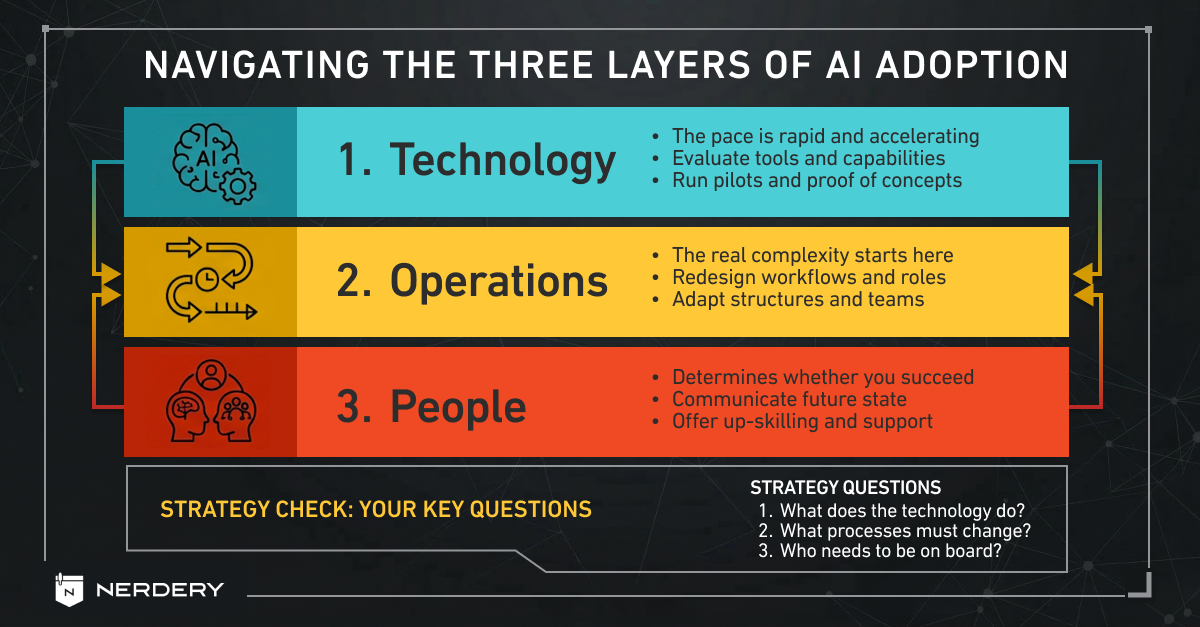
Navigating the three layers of AI adoption info graphic that breaks down core actions around technology, operations and people.

01. The technology layer

The technology layer is where most of the conversation lives today. Which tools, which platforms, which capabilities? The pace here is real. By the time you evaluate a tool, three new ones have shipped. Understanding how to leverage what’s emerging to create competitive advantage, or at a minimum, stay relevant, is a legitimate challenge.

But despite that, the technology piece is still the most straightforward of the three. You can evaluate tools. You can run pilots. You can measure results. Technology decisions can be made by a team. The next two layers require alignment across multiple departments or even the entire organization.

02. The operating model layer

The operating model layer is where complexity enters the equation. This is the structure underneath the work: your workflows, team structures, roles, and delivery processes. AI doesn’t just speed these up. It makes many of them obsolete and creates new ones that didn’t exist before.

For example, when we looked at our own software development lifecycle, we realized we couldn’t just add AI tools to our existing process. The practice was built for a world where every line of code was written by a human. We had to redesign from the ground up: roles, team structures, how we define a project, and how we deliver.

If you adopt AI tools without rethinking how your organization operates, you’ll find the technology moving faster than your processes can absorb. The old ways of working quickly become the bottleneck.

03. The people layer

The people layer is the one that determines whether any of this succeeds. People are naturally resistant to change. That resistance isn’t irrational. It’s a response to being asked to let go of something that works for something that hasn’t been proven yet.

How do you lead your team through that?

We started by making the case for why the change was mandatory, not just for our company, but for the careers of each person.

Then we painted a future state concrete enough that the affected people could see their role in it, not an abstract vision but a specific picture of what we believe their work looks like on the other side. Finally, we anchored on what isn’t changing: our purpose, our values, the things that make the organization worth being part of.

Those three moves made the difference, helping people move from fear and uncertainty to excitement and a desire to be part of the change.

Get this layer wrong, and the other two don’t matter.

Start with the end in mind

The framework gives you a way to structure your thinking, but it doesn’t give you a formula. That’s the nature of the three-body problem: each layer is constantly influencing the others. A decision in one forces adjustments in the others.

As you work through AI decisions, start with the outcome you’re trying to achieve and pressure-test it across all three layers:

  1. What does this technology actually do, and does it achieve the outcome you’re after?
  2. If it works, what processes, roles, or workflows need to change to support it?
  3. Who needs to be on board, what skills will they need, and what’s standing in their way?

But don’t expect to run through this once and have your answer. The layers interact. The leaders who navigate this well aren’t the ones with the best plan. They’re the ones who approximate, iterate, and adjust as the picture becomes clearer.

About the AI From the Inside Series

AI From the Inside is a series exploring the realities of leading a company through AI transformation. Drawing on 20+ years of building a digital consultancy, Nerdery’s CEO and founder, Michael Schmidt shares firsthand accounts of navigating this shift both internally and alongside our clients. These articles move past the hype to focus on the practical challenges of aligning technology, operations, and people. 

Ready to transform your technology, operations, and people?

Start building your digital ecosystem