
When Vibe Coding Becomes a Liability
In this article: Over the past year, many teams have used AI to vibe-code software their businesses now depend on.

Trevor Tillery
Senior User Experience Designer
For product leaders, CTOs, and business executives, AI has fundamentally reshaped the reality of digital product development.
Tools that generate screen mockups, interactive prototypes, visual UI components, and functional code in minutes have dramatically compressed the time it takes to move from concept to execution. Tasks that once required weeks of effort can now be kick-started in seconds with refined requirements, prompts, and constraints.
This shift raises an inevitable question for leaders making software investments: If AI can generate designs instantly, what is the real ROI of working with a product designer?
We see this as a pivotal moment for digital strategy. The true value of product design isn’t disappearing; it is maturing. As manual execution becomes automated, product design is shifting away from simple pixel-pushing toward cross-collaborative systems thinking, strategic problem framing, visual curation, and business accountability.
Here is how the role of design is evolving, and why this shift is essential for leaders building resilient, high-impact digital products in the age of AI.
As AI tools saturate the market with instant visuals, digital products are rapidly becoming homogenized and predictable. While AI can build screens at scale, relying on AI output alone produces generic experiences that may not deliver against organizational goals and often forfeit the type of brand distinction that builds loyalty. Without strategic curation, AI simply gives teams the power to ship a half-baked user experience in record time.
This shift is reflected across the entire tech ecosystem. According to Figma’s 2026 AI Report, 57% of product builders state that design is more important now than before AI, a figure that rises to 65% among software engineers. As code execution becomes commoditized, strategic design and visual curation are where product value accrues. While AI can generate visuals and a facade of polished designs/code at record speed, it cannot decide what is worth building.
Breaking through the noise requires two distinctly human capabilities: creative curation and strategic problem framing.
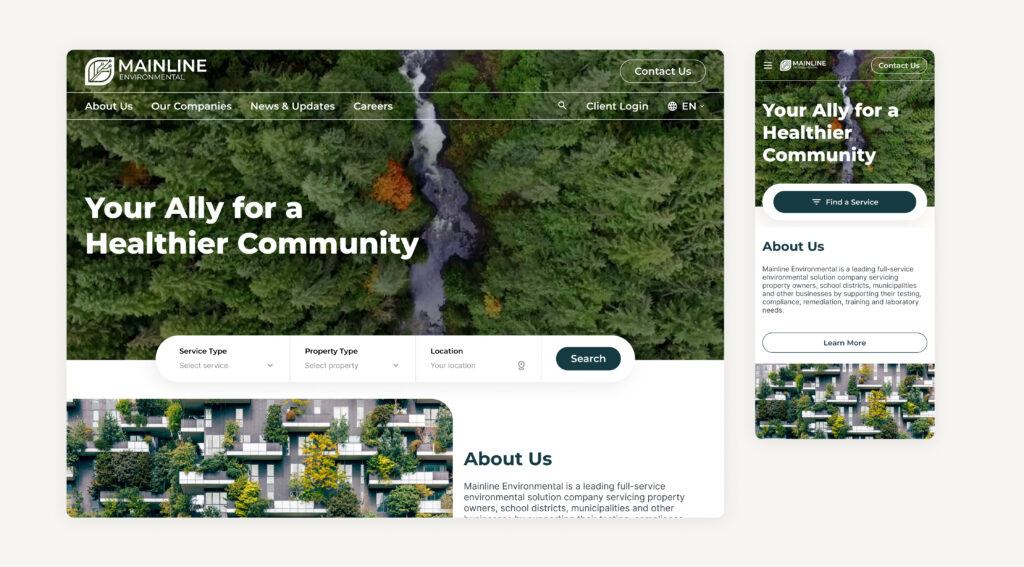
Take a recent engagement with Mainline Environmental, a rapidly growing environmental solutions company acquiring regional brands across the Northeast and soon nationwide. Each acquisition arrived with its own distinct brand, website, and customer portal. An AI tool could have easily generated a generic, unified dashboard template to apply across all of them. However, we understood that a different approach would better serve the organization. We built a reusable, templated design system,so Mainline can now onboard new acquisitions at scale, while still maintaining each regional brand’s unique visual identity and distinct character.
However, visual distinction is only half the equation. Designer Tanner Christensen makes this point well: an AI tool can find the layout that lifts conversion, but it can’t decide whether conversion is the right goal. That depends on questions only your team can answer:
AI can explore possibilities at record speed, but humans must curate the output, frame the underlying problems, and take accountability for the business consequences. That is where strategic product design delivers real ROI.
For years, product design was heavily focused on the traditional screen flow: User opens app > User clicks button > User navigates to the next screen.
That paradigm is evolving rapidly. Figma reports that 83% of product teams are building AI-powered features or products. Designing for AI experiences is fundamentally different from traditional logic-based flows. This is because autonomous agents introduce non-deterministic behaviors, meaning the system can respond differently based on context.
With the rise of platform-level AI and autonomous agents, many screen-based experiences are collapsing into intents and background actions. In a recent UX Collective piece, designer Heenesh Patel argues that when this happens, the experience moves out of the screen and into the system’s architecture. That’s what we’ve seen on client work, and it calls for a different toolkit:
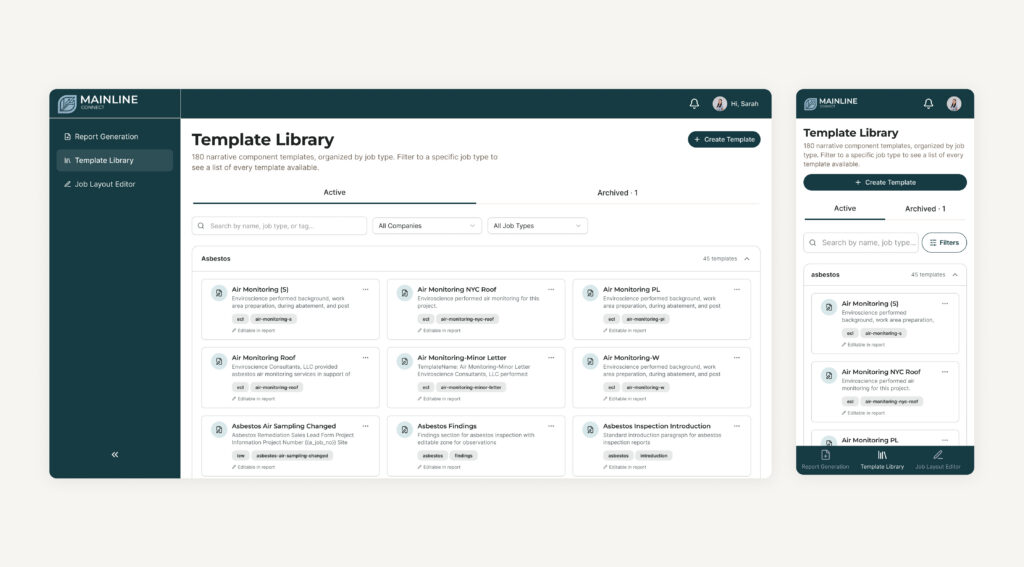
To see this in practice, let’s look back at the Mainline Environmental project. Mainline wasn’t just dealing with multiple brands and websites; their field technicians were manually assembling customer compliance reports from scratch, each working within separate legacy portals left over from their acquisitions. They needed a unified ecosystem that tied everything together to increase efficiency and create a seamless experience. Part of this included the creation of their report builder.
By applying systems thinking, we mapped the complex backend logic needed to build a templated report-generation pipeline. We architected a system that shifted their internal workflow from manual creation to streamlined editing, pulling in compliant, pre-built sections based on contextual service data. We then designed the architecture to be agnostic to the underlying data source (whether HubSpot, Zuper, or a future LIMS platform) to ensure the system was resilient to any future technology changes. Had we just used AI to rapidly generate UI screens without mapping this underlying logic first, we would have simply built a broken, disconnected tool faster than ever.
Historically, teams evaluated design progress by the volume of static deliverables produced: Figma files, journey maps, and annotated wireframes. In an AI-accelerated workflow, the role of these artifacts has shifted.
Industry data confirms how quickly workflows are adapting. Figma’s research shows that 61% of product builders are now creating interactive prototypes (up from just 10% a year ago), while 60% of developers now participate in design work and over half of product teams have moved away from linear handoffs entirely.
With tools like Claude Code and generative front-end builders, a prototype is no longer just a visual concept. Artifacts now serve as strategic catalysts. They make complex thinking visible and functional, allowing product managers, engineers, and executive sponsors to interact with a real concept, challenge assumptions, and align faster than ever. This early, functional alignment acts as a critical firewall—preventing teams from accidentally rushing the wrong product into the development phase.
On the Mainline project, this shift was profound. I leveraged Claude Code to directly bridge design and engineering into production-ready code, using a branch-and-pull-request workflow in collaboration with our developers.
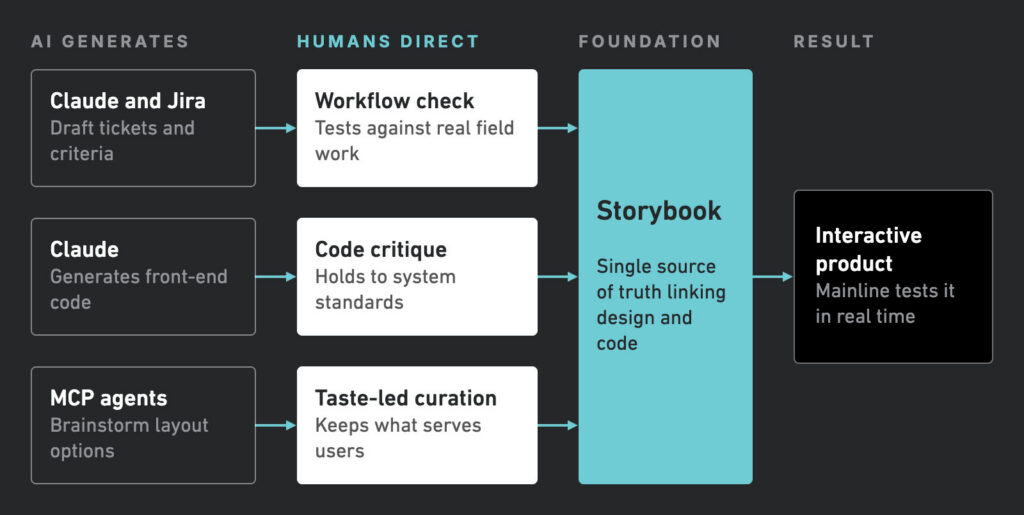
However, the tools only went as far as the human systems and judgment directing them. Ahead of working on a feature, I used Claude connected with Jira to draft tickets, acceptance criteria, and prompts, but human oversight was required to evaluate those criteria against real field-technician workflows and filter out operational blind spots. When using Claude to generate front-end code, I applied my own design curation and architectural critiques to ensure the generated components adhered to strict system standards rather than simply accepting the first code snippet produced. To explore layout variations, I experimented with MCP servers in tools like Pen and Figma, using automated agents to rapidly brainstorm options while relying on human taste to curate the patterns that actually served the user experience.
To maintain system integrity, we anchored everything in Storybook as our unified design system, establishing a single source of truth that enforced consistent rules and bridged design logic directly with the codebase. This balanced workflow did more than accelerate our delivery velocity; it gave Mainline an interactive version of the final product to test and validate in real time.
Because AI handled the heavy lifting of generating initial code-ready builds under human guidance, it freed up design resources to focus on the connective tissue that drives business outcomes:
As AI automates routine production tasks, the traditional silos between product roles are dissolving. Figma’s report highlights that 70% of product builders now use AI to work outside their traditional swimlanes. For organizations, this evolution eliminates the friction of disjointed handoffs. Product design is no longer an isolated phase waiting downstream for requirement documents; it has become an integrated function that unifies product definition, technical feasibility, and delivery.
For leadership, this cross-functional flexibility translates directly into leaner team structures and compressed delivery cycles. When designers leverage AI to accelerate visual exploration and prototyping, companies no longer need convoluted handoff chains just to move an idea forward. A single, systems-focused designer could help define requirements, clarify business logic, and eliminate the costly rework that typically happens when ideas are passed across multiple disconnected teams.
This efficiency was a defining element of our work with Mainline Environmental. Operating as a lean unit powered by AI-enabled workflows, we drastically reduced overhead and prevented misaligned sprints:
This shift represents a significant operational advantage. You no longer need heavy, sequential workflows where concepts pass through four or five different hands before touching reality. By embracing multidisciplinary, AI-empowered product designers, organizations can operate with smaller teams, eliminate handoff bottlenecks, drastically reduce rework, and bring high-quality products to market with remarkable speed.
AI allows organizations to build digital experiences faster than at any point in history. However, building faster also means building the wrong thing faster if your product vision lacks structural clarity.
A successful design practice must be built around strategic foresight:
As AI makes building faster and cheaper, the decisions that come before the build carry more weight. Which problem to solve, which users to serve, and which trade-offs your business can accept will determine the return on every dollar you put into development.
Whether you’re modernizing a legacy platform, adding AI capabilities, or designing a new digital system, staff your team with people who can make those decisions well. That means designers who think in systems, work across functions, and own the outcome.
Related articles
In this article: Over the past year, many teams have used AI to vibe-code software their businesses now depend on.
Automation follows instructions. Generative AI creates content. Agentic AI makes decisions but not alone. The goal isn’t to replace your
If you have been running AI pilots for the past 12 months and struggling to get them into production, then
Start building your digital ecosystem